Chapter 4: The Adventure Kit
The Control Group Coloring Page
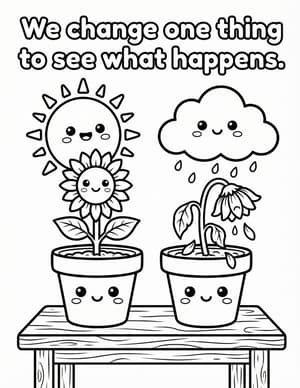
"We change one thing to see what happens."
Two flower pots. One has a sun over it, one has a cloud.
About this page
Two identical flower pots sit side by side, and only one thing differs, a sun shines over the first while a cloud hangs over the second. This is a fair test made visible. By keeping everything else the same and changing just one thing, the Squad will actually know what caused any difference between the flowers. It is one of the most useful thinking tools a child can absorb, and it turns up everywhere once you notice it, including in simple kitchen science experiments you can run this week. Color the two pots the same on purpose, so the sun and cloud stay the only difference.
The research skill
Look closely at the sky over each pot: one flower blooms under a smiling sun, while the other droops under a rain cloud. The skill is checking whether only one thing really changed. A cloud blocks sunlight, but this one also drops rain, so light and water both differ. If the flowers turn out differently, which change caused it? Spotting a hidden second difference is a key Chapter 4 planning skill. Scientists call it a confounding variable, and teachers look for it in science fair projects.
Try it at home
Set two same-size ice cubes on two matching plates (with an adult). Put one plate in a sunny spot and one in the shade: that is your one change. Ask your child to predict which cube melts first, then check every few minutes. Next, run it again with a sneaky second change: a big cube in the sun and a small one in the shade. Ask whether the sun still deserves all the credit. It is the same puzzle as the rain cloud on this page.
Talk about it while you color
- Which flower do you think will grow taller, the sunny one or the cloudy one?
- Why do you think the Squad kept both pots exactly the same except for the sky?
- What is one thing we could change at home to see what happens?