Chapter 2: The Library of Leaves
Connecting Threads Coloring Page
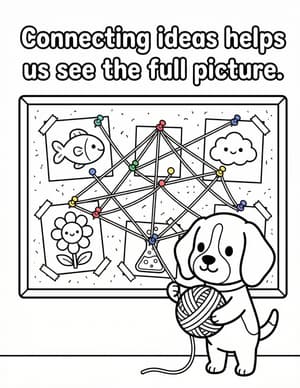
"Connecting ideas helps us see the full picture."
A corkboard with pictures connected by strings (yarn).
About this page
A corkboard covered in pictures, with strands of yarn stretching between them, gives children a detective's-eye view of what thinking actually looks like. Each string says these two things go together, and following the strings reveals a bigger picture no single clue could show. This is synthesis, the skill of connecting separate ideas into understanding, presented in a form kids can literally trace with a finger or a crayon. It is one of the richest pages for conversation, as Professor Hoot's library guide points out, because every child will connect the pictures a little differently.
The research skill
Detail Dog holds a ball of yarn in front of a corkboard where strings link picture to picture. The skill is concept mapping, showing how separate facts relate by drawing lines between them. Researchers do this when their reading piles up and they need to see which ideas support, contradict, or explain each other. Chapter 2 ends in this kind of big picture, built from many sources. In school, it shows up as mind maps and webs, and it helps with planning essays and projects later.
Try it at home
Have your child draw six simple pictures on separate scraps of paper, all about one topic they like, such as the ocean: a fish, a wave, a boat, the sun, sand, and a shark. Lay the pictures on the floor or tape them to a door. Using yarn, string, or ribbon, your child connects any two pictures that go together and explains why. There are no wrong links, only reasons. When the web is done, ask which picture has the most strings, and why.
Talk about it while you color
- Pick two pictures on the board. Why do you think a string connects them?
- If you added one more picture to the board, what would it show?
- What color yarn would you use for the most important connection?