Chapter 3: The Great Guess
Focused Look Coloring Page
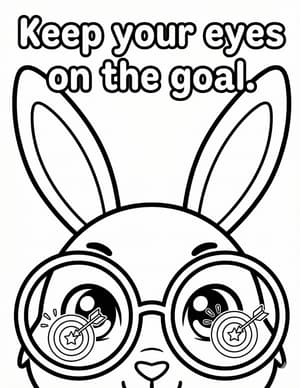
"Keep your eyes on the goal."
Close up of Curious Bunny's eyes reflecting a goal.
About this page
The book zooms all the way in for this one, filling the page with Curious Bunny's wide eyes and the goal shining inside them. After brainstorming, choosing, and sharing, the story is teaching focus, the skill of holding one clear question steady while distractions swirl. For young researchers, focus is what turns a fun guess into something worth testing, and knowing what you are looking for is part of what makes a hypothesis different from a guess. Coloring a close-up like this invites slow, careful work too, so let the page set the pace.
The research skill
Bullseye targets shine in both lenses of Curious Bunny's round glasses. The skill is choosing exactly what to watch. An experiment can produce dozens of details, and a researcher decides ahead of time which one answers the question. Watching everything often means noticing nothing clearly. This ties off a Chapter 3 thread: a good hypothesis names its target, so you know where to look. In school, the same skill shows up whenever a teacher reminds students to answer the question that was actually asked, not a different one.
Try it at home
Try a one-target watch. Choose a window view or a houseplant, and pick a single thing to observe for ten minutes: only birds, or only one leaf. Your child draws a small bullseye on paper and draws that one thing in the center. Set a timer, and each time they notice something new about their target, add a mark around the rings. Afterward, ask what else was happening that they chose to ignore, and whether focusing on one thing helped them notice more.
Talk about it while you color
- What do you see reflected in Curious Bunny's eyes, and what would be in yours?
- What is something you wanted so much that you could not stop thinking about it?
- What helps you keep going when something is hard to finish?