Chapter 4: The Adventure Kit
The Microscope Coloring Page
"Looking closer at the little details."
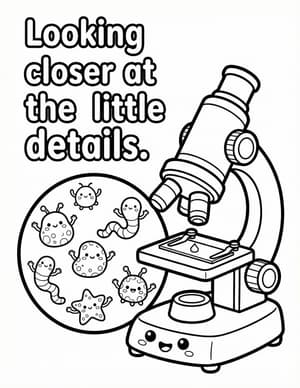
A giant microscope. Underneath, little microbes are smiling and waving.
About this page
Under this giant microscope, a crowd of tiny microbes grins and waves hello. The page makes a whole invisible world feel friendly, and it teaches that some of the best discoveries are hiding in the smallest details. Tools like microscopes extend our senses, letting researchers see what eyes alone cannot. For a young colorist, all those little characters reward the same close attention the page is celebrating. Slow, detailed looking is a skill you can practice on any page, and these questions to ask while coloring are built to spark exactly that kind of noticing. Say hi to the microbes while you are down there.
The research skill
The artwork pairs a giant microscope with a magnified circle full of smiling, waving microbes. That circle is the key detail: it shows what the tool reveals, not what the eye alone can see. The skill is comparing an observation with and without a tool, and noting which is which. Researchers record how something was observed, because a detail visible under magnification may be invisible otherwise. Chapter 4 treats tools as part of the method, and school science later adds magnification numbers and careful observation drawings.
Try it at home
Do a with-and-without observation. Pick a leaf, a piece of fabric, or a slice of bread. First, your child draws it as it looks to bare eyes. Next, look again through a magnifying glass, or through the side of a clear glass of water (with an adult), which can make things look bigger. Draw that view inside a circle, like the microbe circle on this page. Label the two drawings "eyes only" and "with a tool," and compare what changed.
Talk about it while you color
- What is the tiniest thing you have ever looked at really closely?
- If you could shrink down and visit the microbes, what would you say to them?
- What do you think the microbes are waving about?