Chapter 4: The Adventure Kit
The Telescope Coloring Page
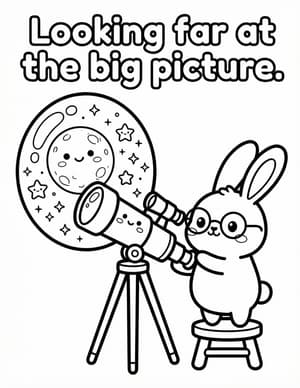
"Looking far at the big picture."
A giant telescope pointing at the moon.
About this page
After peering down at the microbes, the Squad swings a great telescope up toward the moon. Paired with the microscope page before it, this scene completes a lovely idea, that research means choosing your distance. Sometimes you zoom in on tiny details, and sometimes you step back to see the big picture, and both views are true at once. Telescopes, like microscopes, are tools that stretch what our eyes can do. A clear night and a pair of binoculars turn this page into real screen-free STEM time, no lab required. The halfway point of the book ends with eyes on the sky.
The research skill
Curious Bunny, perched on a stool, peers through a telescope at a smiling moon. Beyond the tool itself, the skill here is repeated observation over time. One look at the moon shows a single shape. Looking every night for a couple of weeks reveals that the shape changes in a pattern, something one glance could never show. Chapter 4 plans how often to observe, not only what to use. Astronomers have long studied the sky this way, and in school it appears as moon journals and weather logs.
Try it at home
Start a five-night moon journal. Fold a sheet of paper into five boxes and write a date in each. Every evening, step outside or look through a window with your child and draw the moon's shape in that night's box, or draw clouds if it is hidden. After five nights, lay the drawings side by side and ask what changed. Your child will spot a pattern that one night could never show, and even a cloudy box counts as data.
Talk about it while you color
- What would you want to look at first if this telescope were yours?
- What do you think the moon looks like up close through the lens?
- How is looking through a telescope different from looking through a microscope?