Chapter 4: The Adventure Kit
Ethics Police Coloring Page
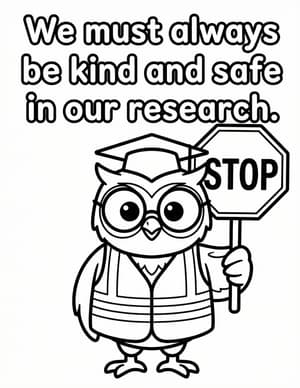
"We must always be kind and safe in our research."
Professor Hoot holding a stop sign.
About this page
Professor Hoot raises his stop sign on page 55, and the whole adventure pauses for the most important rule of all. Before any experiment begins, researchers agree to be kind and safe, to people, to animals, and to themselves. Real scientists call this ethics, and it is never an afterthought, it comes first. For young children, the idea lands simply: we check with a grown-up, we are gentle with living things, and we stop when someone says stop. It is the same ground rule that makes hands-on kitchen science experiments at home both fun and worry-free.
The research skill
Checking for safety and asking permission before starting is called research ethics, and Professor Hoot's safety vest and stop sign make the idea easy to see. Real studies involving people or animals are reviewed before they begin, and participants can always say no or stop partway through. In Chapter 4, where the Squad is planning its experiments, this check belongs inside the plan itself, not tacked on at the end. Children meet the same idea at school through classroom pet rules, lab safety talks, and simply asking, "Is it okay if I...?"
Try it at home
Before your next kitchen or backyard activity, run a family safety check together.
- Ask your child: could this hurt anyone, including an animal or a plant?
- Decide who needs to say yes first, such as a grown-up or the sibling whose toy you are borrowing.
- Agree on a stop word anyone can call at any time.
- Draw a stop sign on paper and let your child hold it up whenever a rule needs a reminder, just like Professor Hoot.
Talk about it while you color
- Why do you think Professor Hoot wants everyone to stop before they start?
- How could the Squad be extra gentle with the snails they are studying?
- What is a rule that keeps you safe when you try something new?