Chapter 4: The Adventure Kit
The Grid Coloring Page
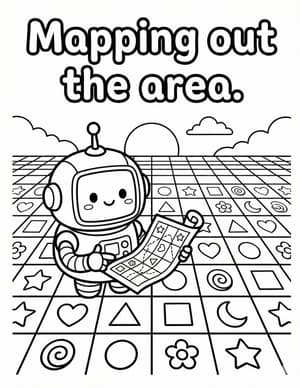
"Mapping out the area."
Subby standing on a grid floor.
About this page
On page 56, the floor beneath Subby has turned into a giant grid, and suddenly the whole space can be described one square at a time. Grids are how researchers make sure they search everywhere without missing a spot or counting the same spot twice. It is the difference between wandering and mapping. Kids meet this idea in treasure maps, checkerboards, and sidewalk squares, so it feels instantly familiar. And because Subby the Robot is the Squad's friendly tech helper, this page also hints that computers love grids too, since they think in tidy rows and columns.
The research skill
Recording where things are with a grid is a real field method, and Subby's map shows how it works. Each square on the floor has a matching square on the paper, so a heart, a star, or a crescent moon can be noted by its exact spot. Researchers mapping plants, fossils, or bird nests divide an area into squares so they can search it evenly and find things again later. It fits Chapter 4 because a grid is a plan for how to look. In school, it returns as map coordinates and graph paper.
Try it at home
Turn a floor or tabletop into a grid of three rows and three columns using painter's tape, yarn, or chalk outdoors. Label the rows A, B, and C and the columns 1, 2, and 3. While your child looks away, hide a few toys in different squares. Your child then searches square by square and draws a matching grid on paper, marking where each toy turned up, like "teddy in B2." Swap roles next, and follow your child's map to find what they hid.
Talk about it while you color
- If you dropped a toy somewhere on this grid, how could Subby find it square by square?
- What places in your home have squares or grids hiding in them?
- Which square would you stand on if you were exploring with Subby?