Chapter 5: Counting the Treasure
The Spreadsheet Coloring Page
"Rows and columns keep us tidy."
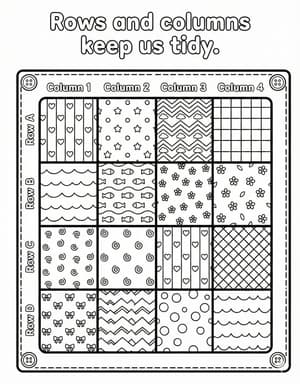
A grid that looks like a quilt. The child colors the pattern.
About this page
Curious Bunny and the squad have gathered so many observations that they need a tidy place to keep them all, and this page shows the answer, a simple grid where every fact gets its own little square. Coloring the quilt-like pattern lets children feel how rows and columns bring order to a jumble, the same way scientists use tables and spreadsheets. It is a gentle reminder that data is everywhere, and that organizing it is the first step toward understanding it, right in the heart of the counting chapter.
The research skill
Every square on this quilt has an address. The rows are labeled A to D down the side and the columns 1 to 4 across the top, so the fish square is B2 and the bows sit in D1. That is the core of a data table: each piece of information lives where one row meets one column, so anyone can find it again. In Chapter 5, this is how counted treasure becomes something you can sort and compare. Later, your child will meet it in school tally charts, map grids, and spreadsheets.
Try it at home
Turn a muffin tin or an egg carton into a tiny data table.
- Label the rows with letters and the columns with numbers on strips of paper.
- Sort buttons, dry pasta, or bottle caps into the cups, one kind per row (with an adult, since small pieces are a choking hazard).
- Call out an address like "B3" and let your child tell you what is inside.
- Swap roles, so your child gives the address and you have to find it.
Talk about it while you color
- Which colors will you repeat to make a pattern in the quilt, and which squares will be surprises?
- If you kept a grid of your whole day, what would you put in each little box?
- Where have you seen rows and columns before, maybe in an egg carton or a calendar?