Chapter 6: Telling the Story
The Structure Coloring Page
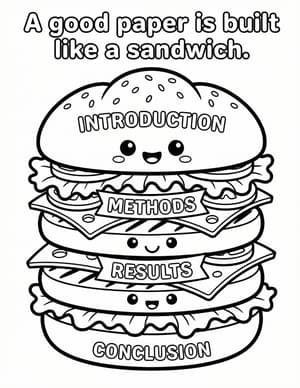
"A good paper is built like a sandwich."
A sandwich. Top bun (Intro), Meat/Veggie (Methods/Results), Bottom bun (Conclusion).
About this page
How do you explain a whole adventure so people can follow it? The squad's answer is delicious, build it like a sandwich. The top bun introduces the question, the filling holds what you did and what you found, and the bottom bun wraps everything up with a conclusion. This playful picture gives children their first feel for structure, the invisible skeleton behind every report and paper on the road from observation to publication. While they color each layer, they are quietly learning that stories and science both need a beginning, a middle, and an end.
The research skill
The smiling sandwich has four labeled layers: Introduction, Methods, Results, and Conclusion. That order is the standard structure of a scientific paper, sometimes shortened to IMRaD. Each layer answers one question: why did you look, how did you look, what did you find, and what does it mean? In Chapter 6, knowing the order helps a young writer decide where each idea belongs. The same shape returns in lab reports, science fair boards, and even school essays, which also need a clear beginning, middle, and end.
Try it at home
Build a paper sandwich report.
- Cut two bun shapes and two filling layers from paper (with an adult for the scissors).
- Pick something your child tested recently, even something tiny like which cereal gets soggy first.
- On each layer, draw or dictate one part: the question, what they did, what happened, and what it means.
- Stack the layers in order, then shuffle them and let your child rebuild the sandwich in the right order, top to bottom.
Talk about it while you color
- What would you put in the middle of your story sandwich?
- Why do you think a story needs a top and a bottom, like buns?
- If you made a sandwich about your day, what would each layer be?