Chapter 3: The Great Guess
The Scale Coloring Page
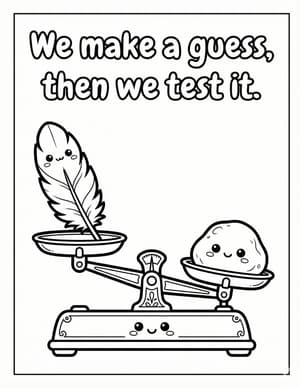
"We make a guess, then we test it."
A balance scale. One side has a feather, the other a rock. The child colors them to show which is heavier.
About this page
A feather and a rock sit on opposite sides of a balance scale, and your child gets to decide how the picture tips. This page turns the core loop of Chapter 3 into a single image, first we guess, then we test. Most kids will confidently predict the rock is heavier, and that confidence is the point, because a hypothesis should be stated before the scale settles. If the result ever surprises us, even better, since wrong answers are the best part of science. Try recreating this scene at home with your own two objects and a pair of hands as the scale.
The research skill
The artwork already shows the outcome: the rock side sits lower, and the feather rides up. The skill hiding here is separating how something looks from what you can measure. Big things are not always heavy and small things are not always light, so researchers trust a tool over a first impression. A balance scale makes the comparison fair because both items face the same test at the same moment. Chapter 3 guesses meet reality this way, and in school it grows into measuring mass, length, and time.
Try it at home
Build a hanger balance with a clothes hanger hooked over a doorknob and a sock hanging from each end. Then:
- Pick two household objects of different sizes, like a big dry sponge and a small metal spoon.
- Ask your child to predict which side will sink lower, and why.
- Drop one object into each sock and watch.
Try several pairs where the bigger object is lighter. Your child will quickly discover that size can fool you, while the balance cannot.
Talk about it while you color
- Before we color it, which side do you think should hang lower, and why?
- Can you find two things in this room and guess which one is heavier?
- What would you think if the feather side went down instead?