Chapter 5: Counting the Treasure
Missing Data Coloring Page
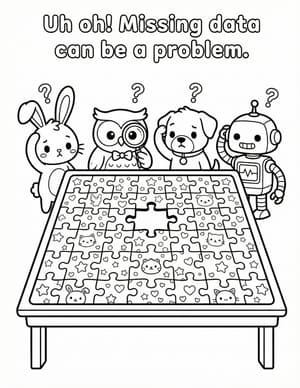
"Uh oh! Missing data can be a problem."
A puzzle with a piece missing. The Squad looks confused.
About this page
The puzzle is almost finished, but one piece is missing, and the Squad's puzzled faces say it all. Page 73 teaches something most books skip: research does not always go smoothly. Sometimes a measurement gets lost, a page gets smudged, or nobody remembered to count on Tuesday, and the picture ends up with a hole in it. Good researchers notice the gap, admit it honestly, and decide what to do next. Keeping careful records, the way Detail Dog keeps his data journal, is the best protection against missing pieces. Even so, every scientist loses one sometimes, and that is okay.
The research skill
Handling missing data honestly is the skill the Squad is puzzling over. The owl peers through a magnifying glass at the gap while the others scratch their heads. When researchers find a hole in their data, they first report it, then study the surrounding pieces for clues about what might belong there, while being clear that any fill-in is a best guess, not a fact. The puzzle's stars, hearts, and little animal faces offer exactly those clues. Older students meet this when a survey question goes unanswered.
Try it at home
Play a missing-piece detective game. Lay out a repeating pattern, such as crayons in the order red, blue, red, blue, or draw a row of stars and hearts that alternate. While your child closes their eyes, remove one crayon or cover one drawing with a scrap of paper. Your child studies the pieces around the gap, predicts what is missing, and explains why. Lift the paper to check. Make the pattern longer or trickier each round, then let your child hide a piece from you.
Talk about it while you color
- Where do you think the missing puzzle piece could be hiding?
- What could the Squad do to figure out what the missing piece looked like?
- Have you ever lost a piece of something, and how did you solve it?