Chapter 3: The Great Guess
The Blueprint Coloring Page
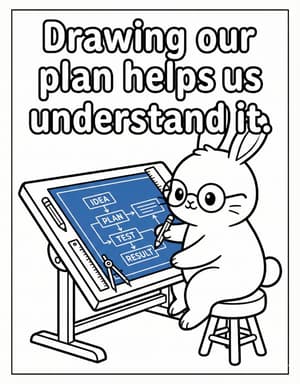
"Drawing our plan helps us understand it."
Curious Bunny drawing a diagram on blue paper with white lines.
About this page
Curious Bunny trades wondering for drafting on this page, sketching white lines across blue paper like a tiny engineer. The message for kids is that drawing an idea is a way of thinking about it. Putting a plan on paper forces you to notice missing pieces, and a diagram you can point to is a plan you can improve. Blueprints also make it safe to be wrong early, when changes only cost an eraser, which is one more reason wrong answers are the best part of science. Coloring this page is itself a kind of drafting, slow, careful, and thoughtful.
The research skill
The bunny's blue drawing is more specific than a sketch: it is a flowchart reading Idea, Plan, Test, and Result. The skill is mapping a research process in order, so you can see what comes next and where you are right now. Flowcharts also reveal missing steps, like jumping to a test with no plan. This page bridges the guessing of Chapter 3 and the experiment planning that follows. Students meet the same four boxes later as the scientific method, and research teams still sketch flowcharts before big projects.
Try it at home
Draw a four-box flowchart for a tiny experiment, such as "Which toy car rolls farthest down a book ramp?"
- Idea box: your child says a guess.
- Plan box: draw the ramp and the cars.
- Test box: roll each car and mark where it stops with a sock.
- Result box: draw the winner.
Tape the flowchart to the wall and point to each box as you go, so your child watches a plan turn into a result, one box at a time.
Talk about it while you color
- What do you think Curious Bunny is drawing a plan for?
- If you drew a blueprint of your dream fort, what would you put in it?
- Why might drawing a plan first be easier than just starting to build?