Chapter 6: Telling the Story
Peer Review Coloring Page
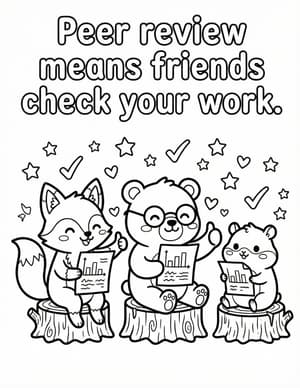
"Peer review means friends check your work."
A fox, a bear, and a hamster on tree stumps, reading the paper and smiling.
About this page
Three new faces appear, a fox, a bear, and a hamster, all reading the squad's paper and nodding. This is the book's gentle introduction to one of science's most important ideas, that before a discovery is trusted, other researchers read it and check it. If you have ever wondered what peer review really means, this page is the whole answer in one picture, friends checking your work. For children, the lesson lands simply, sharing your work with others is not scary, it is how ideas get stronger and how strangers become colleagues.
The research skill
A fox, a bear in round glasses, and a little hamster sit on tree stumps, each reading a copy of the same paper with a bar chart on it. The checkmarks floating above show they have checked it. That is peer review: people who know the subject, but did not do the work, read it closely before it is shared widely. Each reviewer may catch something different, which is why there are three. It is a core step of Chapter 6, and at school it looks like classmates giving feedback with a checklist.
Try it at home
Set up a three-reviewer panel with stuffed animals or family members. Your child makes a quick drawing or chart of something they counted, such as the colors of socks in a drawer. Give each reviewer one job: one checks that the counting is right, one checks that the labels are clear, and one says what they liked best. Your child reads each reviewer's note out loud (you can do the stuffed animals' voices) and decides which changes to make.
Talk about it while you color
- Which reader would you want to hear from first, the fox, the bear, or the rabbit, and why?
- How do you think the squad feels watching others read their paper?
- Who would you ask to check your work, and what would you want them to look for?